
NEWSLETTER: JUNE 2026
Becoming an Evangelizing Catechist
Evangelizing Catechist Basic Course (ECBC) – Module 1 – THE VOCATION AND MISSION OF THE CATECHIST
By Mary Theresa Shiyamathi, Evangelizing Catechist, St. Joseph’s Church, Bagan Serai
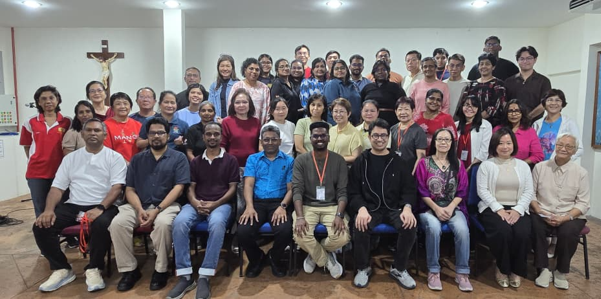
From 31 May to 1 June 2026, 56 Evangelizing Catechists (ECs) and EC Coordinators from the Penang Diocese gathered at Minor Basilica of St Anne, Bukit Mertajam, for the Becoming an Evangelizing Catechist (EC) [Module 1 of Evangelizing Catechist Basic Course] Formation Programme organised by the Penang Diocesan Catechetical Commission (PDCC). Facilitated by seven experienced ECs from various parishes who were guided by Michael Xavier (MSET – Mission Speakers Experience Team) and supported by a dedicated organising team, the formation was aimed at deepening participants’ understanding of their identity, calling, and mission as ECs in today’s Church.
The two-day programme consisted of seven formation sessions covering topics such as the need for a paradigm shift in catechetical ministry, self-evangelization, the role of the Holy Spirit, evangelization and catechesis, personal obstacles in ministry, charisms, and goal-setting for effective catechetical service. Each session was followed by group discussions, allowing participants to reflect on how the themes presented could be applied within their own parish realities.
In his opening session, lead facilitator Mark Stephen emphasised that catechesis is rooted in the kerygma—the proclamation of the Good News through Sacred Scripture, the Gospel message, and personal witness. He reminded participants that the word catechesis originates from the Greek word meaning “to echo.” Thus, the primary mission of a catechist is not merely to teach, but to echo the teachings of Christ and the Church by both word and example. Participants were also encouraged to cultivate a personal relationship with Jesus, recognising that authentic evangelization flows from personal encounter and experience. Throughout the formation, ECs were reminded that one cannot share what one has not personally experienced; effective catechesis begins with a living relationship with Christ and a willingness to witness to His presence in one’s own life.
A distinctive feature of the formation was its deeply prayerful atmosphere. Every session began and ended with prayer, while praise and worship hymns were woven into the programme. Participants were continually encouraged to seek the guidance of the Holy Spirit in both their personal lives and ministry. Beyond learning about evangelization, the formation emphasised the importance of listening to the Holy Spirit and discerning His voice when making decisions, facing challenges, and carrying out pastoral responsibilities.
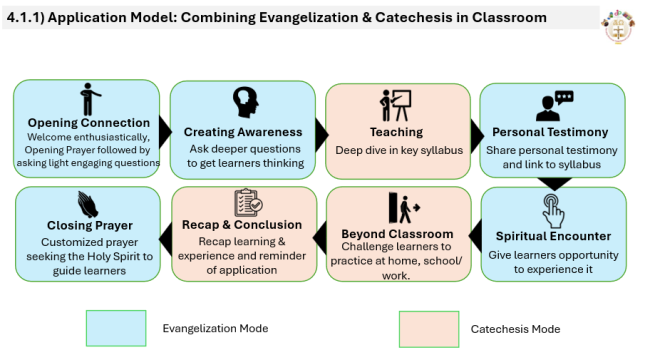
The programme also highlighted an important shift in understanding the role of ECs. Participants reflected on how catechesis extends beyond delivering a syllabus or preparing children for the Sacraments. Rather, ECs are called to accompany young people on their faith journey, helping them encounter Christ in a personal and meaningful way. Lessons should engage not only the minds of students and adults but also their hearts, allowing the Gospel message to take root in their daily lives. The ECs were guided through an application process of incorporating evangelizing and catechesis in the catechism class.
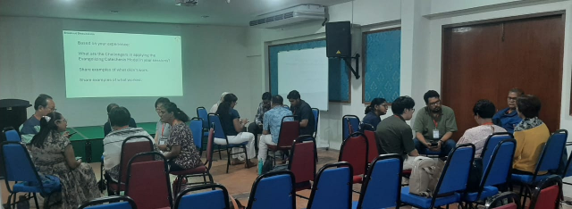
The group discussion sessions provided valuable opportunities for interaction and mutual support. Participants were grouped according to their preferred language—Malay, Tamil, Mandarin, and English—allowing for deeper and more meaningful sharing. ECs exchanged experiences, discussed challenges encountered in ministry, and explored practical ways to strengthen catechetical formation in their respective parishes. These conversations fostered a spirit of fellowship and collaboration among ECs from different parts of the Diocese. New friendships were formed, experiences were shared openly, and participants discovered that many of the joys and struggles of ministry are shared across parish communities.
One of the highlights of the formation was the session on charisms and their role in catechetical ministry. Through guided self-reflection, participants were invited to recognise the gifts and strengths that God has entrusted to them. Understanding these charisms provides valuable insight into how ECs can serve more effectively and how parish leaders can better support the diverse gifts present within their catechetical communities. The session also encouraged participants to appreciate the unique ways in which God equips each person for His mission.
The final session introduced participants to the SMART Goal framework as a practical tool for ministry planning. Through guided reflection and group discussions, participants practised setting specific, measurable, achievable, relevant, and time-bound goals. The exercise encouraged ECs to think intentionally about their ministry and provided a useful foundation for future planning and collaboration within their respective parish catechetical teams.
This formation touched both heart and soul, bringing participants an inner joy that flowed from prayer, reflection, fellowship, and a renewed awareness of God’s call. More than a train-the- trainers/facilitators training programme, Module 1 was a journey of personal formation and renewal. Participants left with a deeper appreciation of their vocation as ECs, a greater awareness of the gifts God has given them, and a renewed commitment to serve under the guidance of the Holy Spirit. The formation also strengthened bonds of friendship and support among ECs, reminding all present that they do not take on this mission alone.
As the first of three planned modules, this formation laid a firm foundation for the journey ahead. It invited participants to recognise that catechesis is not simply a task to be carried out, but a calling to be lived—a calling rooted in personal encounter with Christ, sustained by prayer, and empowered by the Holy Spirit. Inspired by the words of Matthew 5:16, “Let your light shine before others, that they may see your good deeds and glorify your Father in heaven,” participants returned to their parishes with renewed purpose to train/facilitate respective parish ECs so as to serve as authentic witnesses and faithful echoes of the Gospel.
Heavenly Father, strengthen our trainers with patience and joy as they guide the ECs in their respective parishes. Help them to see the potential in every EC, mentoring them with grace and cultivating a positive learning culture that honours you. Amen.
PDCC is the official body that oversees the development of Catechesis in the Diocese of Penang, Malaysia.
Contacts :
- [email protected]
- Rev Deacon Clement
- PDCC Head: 012-435 0566
- Jeanne J Saw
- Communications: 016-455 4597