Renewing catechesis in Asia
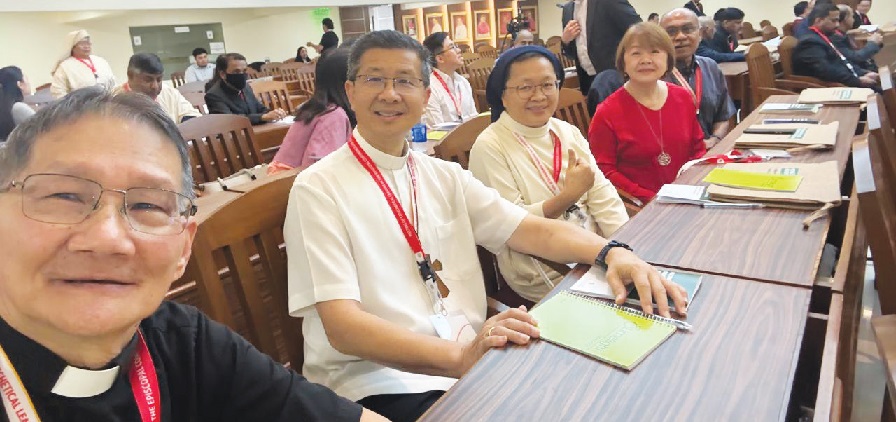
KUALA LUMPUR: From February 11-12, about 50 delegates, comprising bishops, priests, religious and laity from different parts of Asia, participated in the Meeting of Catechetical Leaders in the Episcopal Conferences of Asia. The Catholic Bishops’ Conference of the Philippines (CBCP) hosted the meeting at the Pope Pius XII Catholic Centre in Manila, Philippines.
The meeting was initiated by the Vatican Dicastery for Evangelisation. The Dicastery, which is a department of the Roman Curia established by Pope Francis in 2022, was represented by Bishop Franz-Peter Terbartz- Van Elst and Msgr Eugenio Bruno, both officials of the dicastery. Archbishop Rino Fisichella, Pro-Prefect Dicastery for Evangelisation was unable to attend due to urgent work commitments.
The delegation representing the Catholic Bishops’ Conference of Malaysia-Singapore- Brunei (CBCMSB) was headed by Most Rev Julian Leow Beng Kim, Archbishop of Kuala Lumpur. He serves as President of CBCMSB, as well as, bishop member of the Federation of Asian Bishops’ Conferences Office of Education and Faith Formation (FABCOEFF).
The other delegates were Sr Dariah Ajap (Archdiocese of Kota Kinabalu), Stephanie Ng (Archdiocese of Kuching), Dr Steven Selavaraju (Archdiocese of Kuala Lumpur) and Fr Paul Shie (Apostolic Vicariate of Brunei). There was no representation from Singapore.
The first day’s meeting began with prayer, after which Bishop Daniel O. Presto, Chairman of the Commission on Evangelisation and Catechesis of the CBCP, welcomed the delegates and set the tone for the day. He gently reminded them that the main aim of the meeting is not only to listen to the inputs and participate in discussions but also to learn from each other’s stories.
This was followed by the delegates listening to a video-recorded message from Archbishop Rino Fisichella. The archbishop highlighted the importance of encounter and kerygma in catechesis. Catechesis should lead us to an encounter with Christ and neighbour and to proclaim the kerygma about Christ. This should foster in catechists the call to be evangelisers too.
To assist catechists in discovering and deepening their mission as evangelisers, the Dicastery of Evangelisation has published two key documents in recent years, namely, the Directory for Catechesis (2020) and Motu Proprio Antiquum Ministerium (2022). Both documents have the same objective, that is, to promote the growth of catechesis in the life of the community under the primacy of evangelisation.
The remainder of the day was dedicated to the presentation of reports by each of the fourteen episcopal conferences in attendance. Basically, the reports focused on certain key areas related to the Episcopal Conference: to what extent has the Directory for Catechesis been introduced? How has Antiquum Ministerium been implemented? What are the strengths and challenges faced in the task of catechesis?
In their report, the delegates from CBCMSB, stated among others, that the Archdiocese of Kuching has implemented the directives of Antiquum Ministerium when twenty-two fulltime catechists from various parishes were formally installed to the Ministry of Catechist by Most Rev Simon Poh, Archbishop of Kuching, at the Church of St Ann, Kota Padawan on Aug, 2025.
The proceedings of the first day concluded with the delegates being transported by bus to the De La Salle University where the celebration of the Holy Eucharist was held. It was presided over by His Eminence Cardinal Jose Furte Advincula, Archbishop of Manila. The delegates were warmly welcomed by the staff and students and treated to a sumptuous dinner, as well as entertained by students of the university with a series of cultural dances and songs.
The proceedings of the second day were animated by the FABC-OEFF team. The day began with prayer, followed by a reflection on the topic FABC Documents on Catechesis by a FABC-OEFF representative. Following the reflection, a small group sharing focusing on the task of catechesis in relation to the pastoral priorities of the FABC was held in order to allow the delegates to reflect, contextualise and respond to the challenges and strengths of the churches in Asia. They also reflected and responded to the question as to how the OEFF could support the work of the episcopal conferences and dioceses in catechesis.
The meeting concluded with the celebration of the Holy Eucharist presided over by Bishop Franz-Peter Terbartz-Van Elst at the Parish Church of St Maria Goretti. At the end of the celebration, Msgr Eugenio Bruno thanked the CBCP, those involved in the day-to-day arrangements of the meeting and the delegates for their engaging and active participation.
Most of the delegates shared that they had a fruitful encounter during the two days. This was the first time that many of them had participated at a meeting of this nature. They look forward to similar encounters in the near future and also hope that the meeting will spark greater motivation and collaboration in catechesis among the episcopal conferences in Asia.
Feedback from Malaysian delegates
“I am deeply grateful for the opportunity to participate in the recent Catechetical Leaders’ Meeting in Manila. It was truly an enriching experience to meet catechetical leaders from different parts of Asia. The sharing, dialogue, and encounter with one another were inspiring and life-giving. Listening to the realities, challenges, and creative pastoral responses from other countries broadened my perspective and renewed my hope for catechesis in our region and local diocese. It was also motivating to see the deep commitment of so many who continue to serve the Church faithfully in the ministry of catechesis.
“Two key Church documents guided much of the reflection during the meeting: the Directory for Catechesis and Antiquum Ministerium of Pope Francis. The Directory for Catechesis (2020) reminds me that catechesis today must be missionary, kerygmatic, and attentive to the real situations of people. It calls us to move beyond mere content transmission toward accompaniment, encounter, listening, dialogue and formation in Christian life. The document emphasises that catechesis should help people develop a living relationship with Christ, not simply knowledge about the faith. It also highlights the importance of digital realities, and the need for creative and contextsensitive approaches in our catechetical work.
“Meanwhile, Antiquum Ministerium affirms the importance of the catechist by formally instituting the lay ministry of catechist in the universal Church. This recognition strengthens my understanding that catechists are not merely volunteers, but persons called, formed, and sent by the Church for a vital mission. The document encourages deeper formation, spiritual grounding, and ecclesial identity among catechists, reminding me that catechesis is not only a task but a vocation of service.
“Reflecting on both documents together, I am reminded that the future of catechesis in Asia depends not only on programmes or materials, but on forming missionary disciples who can witness to the Gospel in their own cultures. The meeting in Manila helped me see that although our contexts differ, our hopes are the same: to help people encounter Christ and grow as members of the Church.
“I returned from this meeting inspired, encouraged, and motivated to continue strengthening catechetical ministry in our local Church. I am thankful for this opportunity and for the prayers and support that made my participation possible. The presence, sharing, listening, encouragement, and shared commitment made the experience not only fruitful but deeply meaningful.” Stephanie Ng (Archdiocese of Kuching, Sarawak)
“Attending the Meeting of Catechetical Leaders in the Episcopal Conference of Asia was a true “Emmaus moment” for me. Being with the catechetical leaders from across Asia to discuss the documents of Pope Francis — specifically Antiquum Ministerium — has fundamentally shifted my vision for our local mission.
“The two days of listening, sharing, and presenting were deeply enriching. It was a profound consolation to realise that our struggles in Malaysia, and in my own archdiocese, especially the difficulty of imparting faith to the “digital generation”, are also shared by our brothers and sisters across Asia. We are not struggling in isolation; we are part of a universal Church facing the same “digital era” frontiers.
“The input on Antiquum Ministerium (Institution of the Ministry of Catechist) moved me to see how many Asian countries have already embraced, translated, and implemented this document in their dioceses. My hope is that we, too, will give high priority to the formation of catechists, as recognised by the Church in the document.
“The process of group sharing showed me that when we listen to each other’s strengths and challenges in catechesis and journey with other catechists, we grow stronger together. This is the Synodal Church in action — listening, discerning, and moving forward as one body. “I wish to express my deepest gratitude to Bishop Joseph Hii (Episcopal President for Catechetics) for this invaluable opportunity and for the enriching experience of participating in this meeting.” Sr Dariah Ajap, FSIC (Archdiocese of Kota Kinabalu, Sabah)
PDCC is the official body that oversees the development of Catechesis in the Diocese of Penang, Malaysia.
Contacts :
- [email protected]
- Rev Deacon Clement
- PDCC Head: 012-435 0566
- Jeanne J Saw
- Communications: 016-455 4597