NEWSLETTER: AUGUST 2026
The Architecture of Faith: Why Youth Are the Present Structure
By Marie Ann Dawson
Twenty-five years ago, sitting in the pews of the Cathedral of St. John the Evangelist in Kuala Lumpur, I listened to a homily that stayed with me long after the final blessing. Looking out at the young people gathered in the mother church of the Archdiocese, myself among them, the priest said words that felt both heavy and inspiring: “You are the pillars of the Church.”
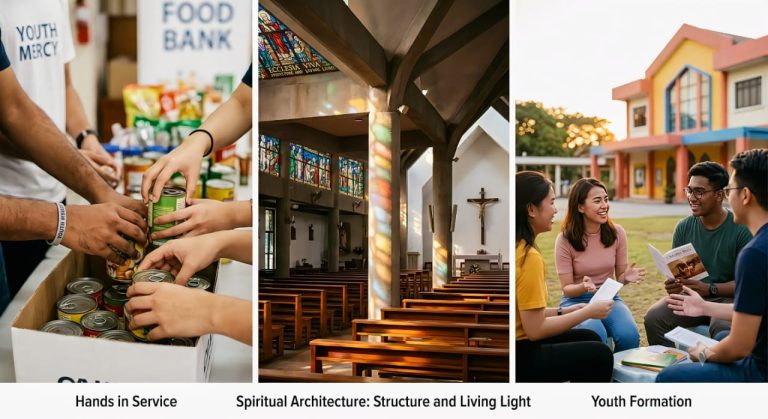
At the time, as a young person navigating my faith, I understood his words quite simply. To me, being a pillar meant an encouragement to roll up my sleeves and serve. It meant joining the parish youth ministry, helping out at food fairs, or singing in the choir. It was about keeping the machinery of parish activities moving, filled with the loud, joyful energy that defines youth groups.
Looking back now, a quarter of a century later, I appreciate the much deeper theological weight behind that phrase. While Christ alone is the true foundation, the cornerstone upon which everything rests, every baptized person is called to help uphold, sustain, and strengthen His Mystical Body. We are not passive spectators in a spiritual building; as St. Peter reminds us, we are called to be “living stones” built into a spiritual house (1 Peter 2:5).
For generations, the prevailing narrative in many parishes has been that young people are the “Church of tomorrow.” We invest in them, organize youth camps, and build catechism programs with an eye toward the future, waiting for the day they are ready to lead. But having walked this path for the last twenty-five years, a journey that eventually brought me from the cathedral in Kuala Lumpur to a new spiritual home here in the Penang diocese, I see the subtle danger in that mindset. It implies that until tomorrow arrives, the young are merely waiting in the wings, consumers of ministry rather than active agents of it.
Pope Francis directly challenged this notion in his post-synodal apostolic exhortation, Christus Vivit (Christ is Alive). Addressing the youth of the world, the Holy Father wrote clearly: “You are the now of God.” They are not the future of the Church; they are its present.
The young people filling our pews today are an essential part of the Church right now. They bring an energy and an authenticity that a healthy community desperately needs to thrive. More importantly, they are on the front lines of evangelization through concrete community service and the works of mercy. Whether it is feeding the hungry, visiting the lonely, or standing up for the vulnerable in modern urban spaces, young people live out the Gospel in places the institutional Church cannot easily reach. When a young person performs a corporal or spiritual work of mercy with integrity among their peers, they become a vital witness to a world searching for truth.
However, being a living stone is a two-way street that requires courage from our current youth and trust from parish leadership. To the young Catholics of today, recognizing yourselves as pillars means realizing that your baptism is an immediate commissioning to serve. Do not wait for permission to be the hands and feet of Christ’s mercy to the world.
To my peers, those of us who were the youth twenty-five years ago and are now the parents, catechists, and parish council members, our call is to open the doors we once knocked on. It means moving beyond assigning youth to superficial tasks and instead trusting them with real shared responsibility in leading these missions of mercy.
The Cathedral of St. John stands as a beautiful testament to the faith of my past, just as the vibrant parishes of Penang form the landscape of my present. But the true strength of our local Church does not lie in its concrete or stained glass. It lies in the people who fill those spaces across generations. By encouraging our youth to be living stones today, we ensure that the building remains structurally sound for the next twenty-five years and beyond.
Author Bio:
Marie Ann Dawson was actively involved in Catholic youth ministry at the Cathedral of St. John the Evangelist, Kuala Lumpur, twenty-five years ago. She now resides in the Diocese of Penang, continuing to journey with the local church community, with a particular focus on special needs catechism
PDCC is the official body that oversees the development of Catechesis in the Diocese of Penang, Malaysia.
Contacts :
- [email protected]
- Rev Deacon Clement
- PDCC Head: 012-435 0566
- Jeanne J Saw
- Communications: 016-455 4597