
NEWSLETTER: JULY 2026
What Does It Mean to Be Human in the Age of AI?
by Jeffry Christopher, Evangelizing Catechist at the Church of St Mary, Tapah
Reflecting on Pope Leo XIV’s first encyclical, Magnifica Humanitas (Magnificent Humanity), May 2026
Artificial intelligence (AI) is now part of our everyday lives. It answers our questions, finishes our sentences, suggests what to watch, and even writes essays. Many of us, whether teachers, parents or children, use it without thinking twice. So, what does our faith have to say about it?
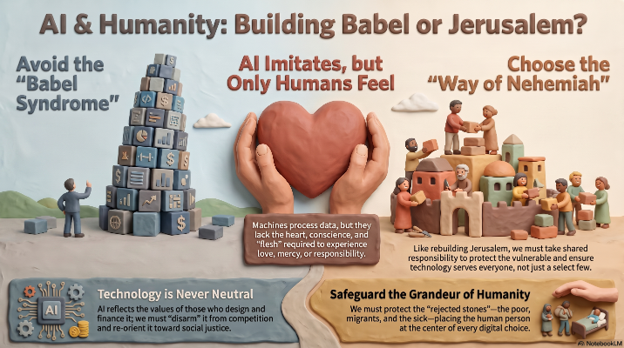
In May 2026, Pope Leo XIV gave us his first encyclical, Magnifica Humanitas. The Pope’s message is both hopeful and clear. AI is not evil, and the Church is not against new technology. However, he reminds us, technology is never neutral as it carries the values of the people who design and use it. So, we must guide it wisely, always asking one question: does this help people truly flourish?
Three simple ideas from the Pope
- We are made in God’s image. Our worth is a gift. The Pope teaches that the dignity of each person is neither acquired nor earned, nor does it need to be justified. It does not depend on what we produce or how useful we are.
- AI can imitate us, but it cannot love. It has no conscience, no empathy, no soul. Love, work and responsibility remain uniquely human.
- We must remain human. The Pope calls us to remain profoundly human and to treasure a grandeur in the person that no machine can ever replace.
For Evangelizing Catechists
AI can be a helpful classroom assistant, but only if it stays a tool and never the teacher of the faith. A few practical ways to begin:
- Use AI to save time, not to replace prayer or witness. Let it help you draft quizzes, brainstorm activity ideas or simplify Scripture passages and then review it carefully, because AI can be confidently wrong.
- Always verify against trusted sources. Compare anything AI produces with the Catechism of the Catholic Church (CCC), the YOUCAT and Church teachings before using it with children.
- Teach discernment, not just facts. Ask your class: “Can a machine pray? Can it forgive? Can it love you?” These questions open beautiful conversations about the soul.
- Protect real encounter. The Pope warns against technology that isolates us. Fill your sessions with discussion, eye contact, shared prayer and human warmth – the things no app can provide.
For Parents
You are your child’s first teacher of the faith, and that has not changed. AI makes your role more important, not less.
- Be curious together. Sit with your children when they use AI. Ask what it told them, and gently talk about whether it is true, kind and helpful.
- Guard family time. Phones and clever apps are designed to capture attention. Protect meals, night prayers and Sunday Mass as screen-free moments of real togetherness.
- Model healthy technology use. Children copy what they see. Let them notice you putting the phone down to listen, to pray, and to be fully present.
- Talk about human dignity. Remind your children that a person is precious because God made them. Not because of likes, followers or how productive they are.
For Children
Here are simple things to remember and try.
- You are wonderfully made. God loves you just for being you. Not for being fast, clever or useful. A computer can never be loved the way God loves you.
- A robot can talk, but it cannot care. AI does not have a heart or a soul. Only people can truly love, forgive and pray.
- Use, then unplug. Enjoy helpful technology, then switch off and play, help at home, and spend time with family and friends.
- Always ask a trusted adult. If something online confuses or worries you, tell a parent, teacher or catechist. Real people are there to help you.
Our hope
Pope Leo XIV does not ask us to fear the future, but to face it as Catholics with wisdom, courage and love. AI may help us heal the sick, educate the young and connect people across the world. But the Pope reminds us, technology is never neutral, and there is a grandeur in the human person that no machine can ever replace. The real question is not how powerful our machines become, but whether we will remember what it truly means to be human. Even in the age of AI, may we bear witness to the grandeur of humanity, in which God has made His dwelling.
PDCC is the official body that oversees the development of Catechesis in the Diocese of Penang, Malaysia.
Contacts :
- [email protected]
- Rev Deacon Clement
- PDCC Head: 012-435 0566
- Jeanne J Saw
- Communications: 016-455 4597