Artificial intelligence (AI) has quietly become part of everyday life. From how we search for information and communicate to how we work and create, AI is increasingly present in our daily routines.
A 2025 Deloitte survey found that 76% of Gen Z and millennials reported using AI in their day-to-day lives. As the technology becomes more accessible, we are moving towards a generation that may have never experienced a world before generative AI became part of ordinary life. That raises an important question, especially for us as members of the Church: What is AI doing to us?
Understanding AI and Gen AI
Artificial intelligence is not new, but generative AI has changed how accessible it has become. Tools such as ChatGPT, Claude, Copilot, Meta AI, NotebookLM and CapCut can now generate text, images, music, video and other forms of content within seconds.
The convenience is remarkable. AI can save time, assist with research, support creativity and make certain tasks easier. But the real concern begins when assistance becomes dependence.
When convenience becomes dependence
Think about the way we communicate in our parishes today. A poster can be designed within minutes. A caption can be generated almost instantly. A speech, image or video can be produced with very little human effort.
There is nothing inherently wrong with using these tools. The question is whether we are still doing the thinking and creating ourselves, or whether we have gradually handed over the process.
Before AI became so accessible, creating something for a parish required us to think, experiment, make mistakes and make decisions. It took longer, but the process required us to put something of ourselves into what we created.
Perhaps we should therefore ask ourselves an uncomfortable question:
“Can I still do these things without AI?”
If we struggle to write a simple caption, develop an idea, prepare a speech or create a basic poster without assistance, perhaps our relationship with AI deserves closer examination. The issue is not that we use technology. The issue is whether convenience has begun to replace our ability, confidence or willingness to do things ourselves.
What is happening to human creativity?
This concern becomes even more significant when we consider the younger generation.
For many of us, developing an idea once meant searching through books, asking another person, trying something ourselves or simply sitting with a problem until we worked it out. The next generation may grow up with AI as an ordinary part of school, work and creativity.
That is not necessarily a bad thing. Every generation learns to use new tools. But there is a difference between using a tool and allowing a tool to replace the development of our own abilities.
If we constantly ask AI to write for us, we practise writing less. If we turn to it whenever we need an idea, we give ourselves fewer opportunities to develop our own imagination. If we rely on it whenever we encounter a difficult problem, we may become less willing to sit with that problem and work through it ourselves.
Human creativity needs room to grow. It develops through mistakes, limitations, conversations, experiences and even frustrations. When everything can be produced instantly, we need to be careful not to lose the value of the creative process itself.
Who is guiding us?
This brings us to an even deeper question for Christians. We have become very good at prompting AI. But are we equally attentive to the promptings of the Holy Spirit?
When preparing something for our parish, our first concern should not simply be whether it looks professional or can be produced quickly. We should also ask whether what we are creating is faithful to our purpose as a Christian community.
This is where prayer and discernment become important.
Pope Francis, speaking at the 50th G7 Summit in 2024, described artificial intelligence as arising from the creative potential God has given human beings. He reminded us that science and technology are products of human creativity and therefore carry a responsibility to serve humanity.
This perspective is important for Catholics. Technology does not exist outside our relationship with God. Human creativity itself is a gift from the Creator. The Book of Exodus reminds us that God gives human beings wisdom, understanding and knowledge for every kind of craft (Exodus 35:31).
Our ability to design, write, imagine, build and create is part of what makes us human. We should therefore, be careful not to surrender that gift simply because a machine can now perform certain tasks more quickly.
AI can assist us, but it cannot replace us
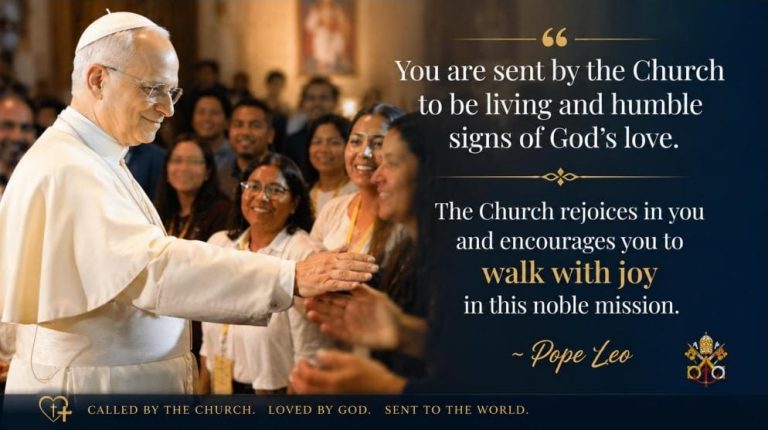
Pope Leo XIV has taken this reflection further in his 2026 encyclical Magnifica Humanitas, which addresses the safeguarding of the human person in the age of Artificial Intelligence. He emphasizes the distinction between artificial intelligence and human intelligence. With human intelligence, conscience and freedom are responsible for guiding technological development.
AI can process enormous amounts of information, recognize patterns and generate content at extraordinary speed. Yet it does not experience the world as we do. It does not grow through relationships or understand love, suffering, responsibility and compassion from within.
Consider the life of a parish. An AI system may help us write a message for a bereavement ministry, but it has never sat beside a grieving family. It may suggest words for a youth programme, but it has never listened to the worries and hopes of a young person.
The human context matters
Generative AI can produce suggestions, but the human person provides the purpose, context and intention. An idea for a parish programme might come from noticing a particular need, a conversation with another parishioner or a moment of prayer and reflection. AI may help develop that idea, but it did not experience the community that gave birth to it.
This is where discernment becomes essential.
The important question is not simply: “What can AI create?” but: “What are we called to create?” These are two very different questions.
So, should Catholics stop using AI?
The answer is not to reject AI or pretend we can return to a world without it. AI will continue to develop, and the Church will encounter it in education, communication, administration, evangelization and many other areas.
AI can help us brainstorm, organize information, check grammar, improve a first draft or save time on routine tasks. What we should avoid is allowing convenience to become a substitute for thought.
Before asking AI to create something for the Church, perhaps we should first ask ourselves what we are trying to communicate and why it matters. We can pray about it, consider the people we are serving and discern whether our work will genuinely help them encounter Christ. Then, if AI can assist us, use it. But we remain the ones making the decision.
Keep the human person at the center
The Church does not need to become anti-technology. At the same time, it should not become an AI-dependent Church. Our task is to remain a discerning Church that knows how to use technology without allowing technology to define us.
We are not called to abandon the tools of our time. We are called to use them responsibly while protecting what technology cannot provide: conscience, human relationship, compassion, faith, creativity and love.
The greatest danger is not that AI will become capable of doing more and more things for us. The greater danger is that we may become so comfortable allowing it to do those things that we gradually forget what we, ourselves, are capable of doing.
Our creativity is not merely a skill that can be outsourced when something more convenient comes along. It is part of the gift of being created in the image and likeness of God.
So, the next time we sit down to prepare something for our parish, let us remember that the most important prompt in the life of a Christian is not the one we give to a machine. It is the invitation for us to receive a prompt from the Holy Spirit.
AI can be our assistant. It should never become our master.